
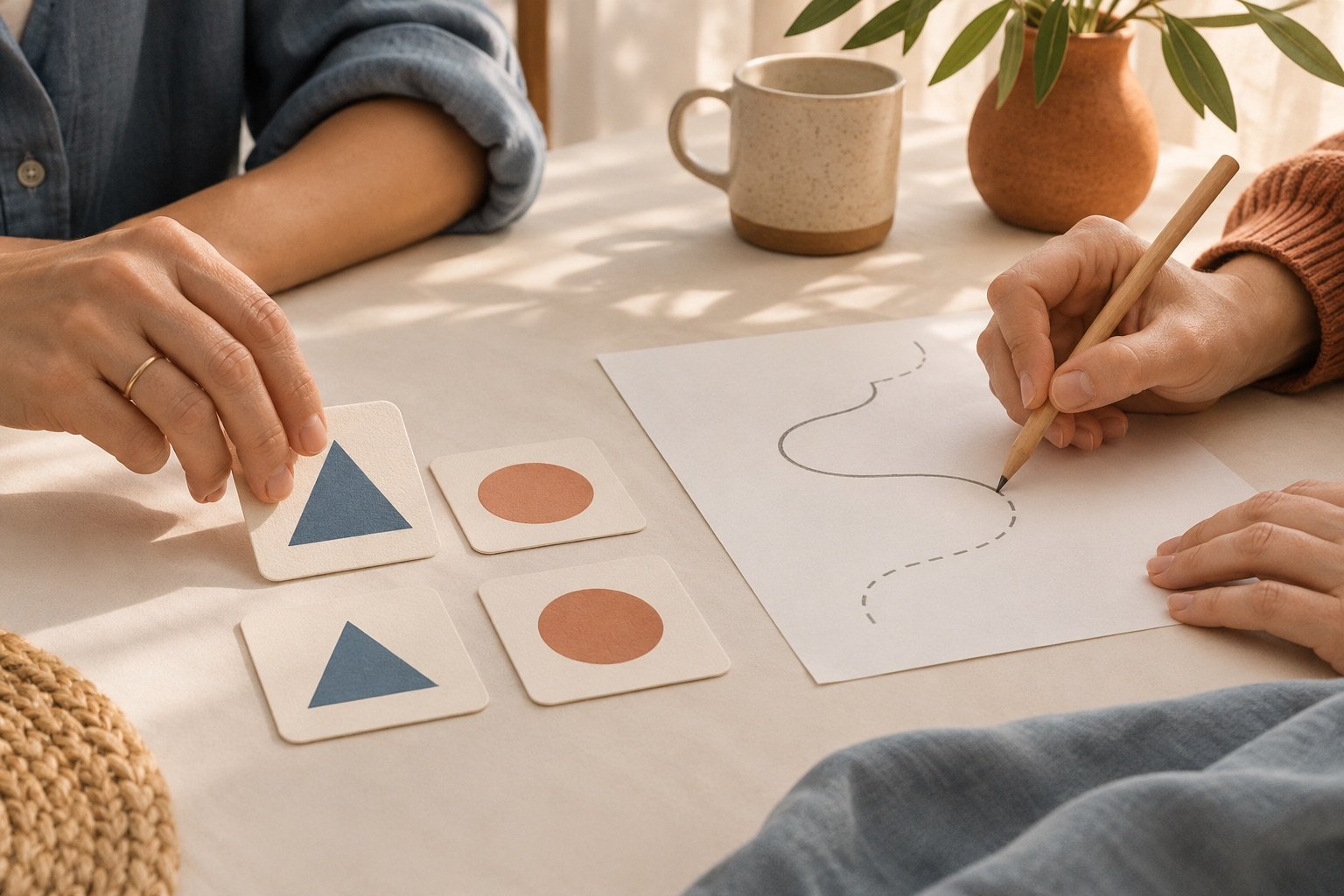
Matching activities can look similar on a page while asking for different kinds of attention. Before using one, check what has to be paired, how many choices appear at once and how participants will show an answer. Those details matter more than the label on the sheet.
Identify the relationship
One activity may pair identical pictures. Another may connect a word to an image, or two items that belong together. Write the rule in one sentence. If you cannot explain why a pair is correct without adding an exception, simplify the set or clarify the instructions.
Count the choices
More items create more comparisons. That can be welcome when the group wants a longer round, but it can also crowd a page. Look at the actual print size or screen view you will use. Check that labels are distinct and that similar marks are not the only way to tell choices apart.
Choose how answers are marked
Players might draw lines, circle pairs, place cards together or say the answers aloud. Drawing lines needs room between items; movable cards need a surface that holds them. Decide whether people will work alone, in pairs or together around a table. The same content can feel quite different under each rule.
Try the instructions before the event
Take a sample turn yourself. Check that every item has the intended match and that the answer can be marked clearly. If several answers seem plausible, revise the set or allow more than one answer. Do not claim a page is suitable for a particular age or ability without looking at the actual people and material involved.
Our matching versus path puzzle guide helps compare the actions, while Printable Activities outlines the broader formats. Kite & Grid offers selection advice here, not a downloadable matching sheet.