
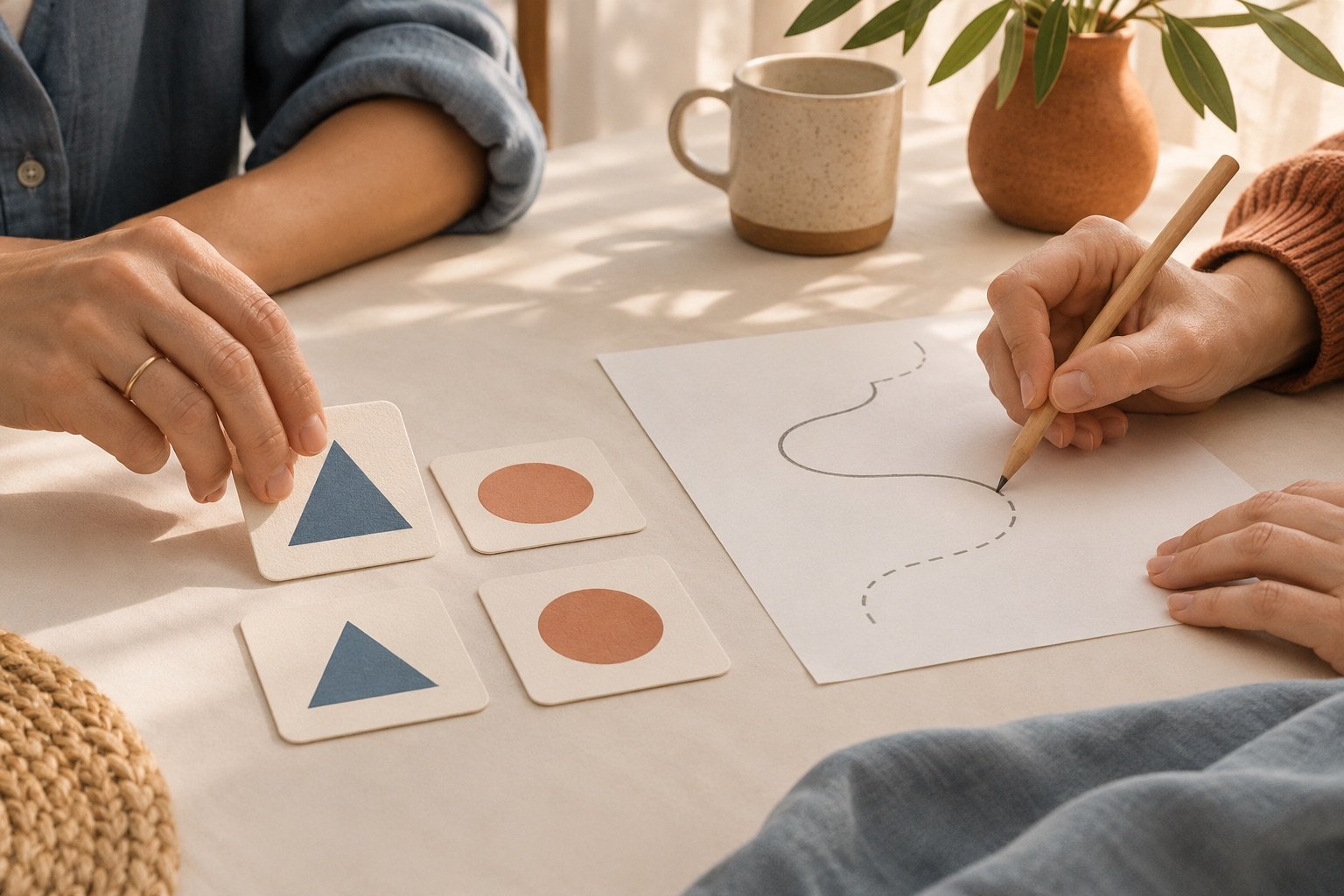
An adult planning quiet table time may have several paper activities to choose from. A matching task and a path puzzle can both fit on a page, but they ask for different actions. Before choosing, look at the actual page or materials you intend to use. Check what a participant will need to notice, mark and understand, as well as the room and time you have.
This is a choice guide. Kite & Grid does not supply a printable activity file or answer key here.
What will participants do?
In a matching activity, someone identifies a relationship between items. They may draw a line between two pictures, pair labels with images, or arrange cards. The key question is what counts as a match. Identical pictures, related objects and two halves of a shape follow different rules. If the intended relationship is unclear, a participant may make a reasonable choice that differs from the organiser’s answer.
In a path puzzle, someone follows or chooses a route from a stated start to a finish. A maze may ask them to avoid dead ends; a tangled-line puzzle may ask them to track one line among several. Check whether the start, finish and route are visible at the printed size. A crowded page can demand more explanation than a simple matching page, so compare the specific examples you have rather than assuming one format is always easier.
Compare the explanation needed
For a matching page, say the rule in one sentence and try the first pair yourself. If there are several plausible matches, either clarify the instruction or choose a different page. Decide how answers will be checked, especially if the page will be used by a group.
For a path puzzle, point out the start and finish and show what counts as a valid route. Are participants allowed to retrace a line, erase a wrong turn or point to an answer instead of drawing it? These choices depend on the actual puzzle and the setting. A short demonstration can be useful for either format.
Check materials and space
A single matching or path page usually needs a surface and a way to respond, such as a pencil, marker or pointing. Loose matching cards need room to spread out and a way to keep each set together. A maze can take little table space, but it still needs a clear print and a surface suitable for tracing. Check the materials you already have before committing to a format.
If you are making or choosing a page for a group, print one test copy at the size you plan to use. Look at the contrast, line width, labels and answer space. Try the first task under the lighting likely to be available. This catches problems that may not be obvious on a screen.
A short pre-use check
- State the action. Will participants pair, sort, trace, point or explain a route?
- Check the first instruction. Can you demonstrate one step without adding an unstated rule?
- Inspect the actual page. Are its images, labels, paths and answer marks clear at print size?
- Match the setup. Do you have the needed surface, copies, marking tools and answer-checking method?
- Plan an adjustment. If a participant needs help, will you show a first step, allow pointing, offer a clearer page or change the task?
Choose the activity whose visible task and setup fit the session you are planning. If you want to compare paper-friendly formats more broadly, start with Printable Activities. For a closer look at paths, matching and other puzzle structures, use the printable puzzles choice guide.